
Sulawesi Black Macaque ‘Yaki’ Faces Extinction as Forests Shrink in North Sulawesi
00:00
00:00


- The yaki, or Sulawesi black macaque (Macaca nigra), is found only in North Sulawesi and is listed as Critically Endangered by the IUCN.
- Scientists warn the species is declining fast due to habitat fragmentation and hunting, with IUCN estimates suggesting around 3,000 remain in the wild.
- Beyond its “punk” crest, the yaki is a key seed disperser, making its survival closely tied to the health of Sulawesi’s rainforests.
The yaki, or Sulawesi black macaque, is an endemic Indonesian primate found only in North Sulawesi. Its scientific name is Macaca nigra, first described by Anselme Desmarest in 1822. Locally, it is known as yaki, wolai, or bolai.
It is instantly recognizable: glossy black fur topped with a distinctive crest. That crest has earned it the nickname “Indonesia’s punk monkey.” But behind its striking look lies a fragile story of shrinking forests and a species under threat.
Taxonomically, the yaki belongs to the family Cercopithecidae and the genus Macaca, part of the Old World monkeys. It is the largest macaque on Sulawesi, bigger than its close relatives on the same island.
Adults measure roughly 44 to 60 centimeters in body length and weigh about 7 to 15 kilograms. Its tail is very short—around 20 centimeters—often making it appear tailless. Many people mistakenly think the yaki is an ape, but it is clearly a monkey.
The yaki’s coat is almost entirely jet black, giving it a bold, almost enigmatic appearance. Its face is hairless and dark, with a pronounced muzzle and strong jaw. Males have large, sharp canines that play a role in fights tied to social rank.
One of its most striking features is its bright pink rump, especially visible in females during the mating period. The contrast between deep black fur and vivid pink skin makes the yaki easy to identify in the wild.
The yaki’s natural home is the tropical rainforest of northern Sulawesi. It inhabits both primary and secondary forests, from coastal areas up to highlands at 2,000 meters above sea level. Key areas include the Tangkoko Batuangus Nature Reserve, Dua Saudara, and Manembo Nembo.
The species depends heavily on dense primary forest for sleeping sites and foraging. When forests are degraded, its living space is immediately squeezed.
Yakis are opportunistic omnivores with a notably broad diet. Research has recorded more than 145 fruit types consumed by yakis, particularly figs in the genus Ficus. They also eat young leaves, flowers, seeds, tubers, insects, mollusks and even small vertebrates.
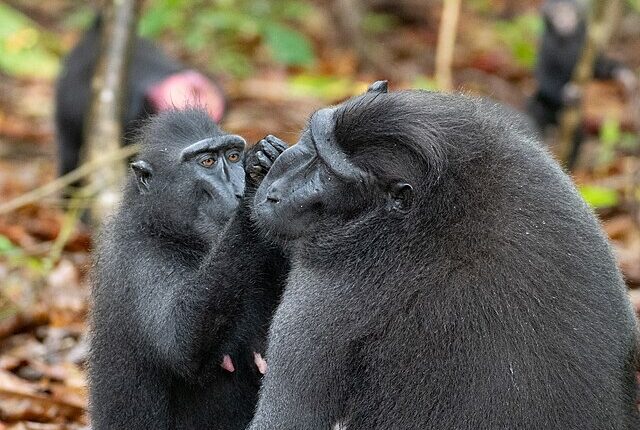
In some places, yakis come down to the shore to forage for shellfish. This flexible diet also makes them an important seed disperser in Sulawesi’s forests.
Socially, yakis live in large groups, averaging around 20 to 70 individuals. Their groups are matrilineal, with females forming the stable core and serving as the social center. Adult males often move between groups after reaching sexual maturity.

According to Lee and Riley in Primate Societies (2010), this system increases social stability. A clear hierarchy is shaped through interactions, vocalizations and body language.
Yakis are active during the day, making them diurnal primates. They are semi-arboreal, moving through both trees and the forest floor. Their home range can reach 320 hectares, with daily travel of up to five kilometers.
Their movement is varied, from occasional bipedal walking to fast climbing. At night, they sleep together in tall, dense trees.
Choosing a sleeping tree is not trivial for yakis. Research by Sylvia Laatung of Sam Ratulangi University, published in Jurnal Zootek (2019), found a strong preference for high canopies.
Yakis tend to choose large trees with dense branching, especially fig trees. These trees serve as natural fortresses against predators such as pythons. Thick canopies also help keep the group cohesive.
The yaki plays a major ecological role in maintaining forest health. By dispersing seeds through its droppings, it supports natural forest regeneration. Rhett Butler, in a Mongabay report dated June 12, 2020, highlighted the primate’s role as a key guardian of biodiversity.
Without yakis, some forest trees risk losing a vital natural seed disperser. The disappearance of the yaki would mean the forest losing one of its ecological architects.
Yet the yaki’s conservation status is deeply alarming. The IUCN Red List has listed Macaca nigra as Critically Endangered since 2008. Over the past three generations, its population has dropped by more than 80 percent.
IUCN data from 2020 estimates that only around 3,000 individuals remain in the wild. The number points to a quiet crisis unfolding in Sulawesi’s forests.
The main drivers of the decline are habitat loss and hunting. Expanding agriculture, mining and infrastructure have fragmented forests into smaller patches. Yakis that enter farmland are often treated as pests and killed.
Hunting for bushmeat also increases during certain celebrations. According to Kyes et al. in Asian Primates Journal (2012), this pressure has hit populations with brutal force.
Conservation efforts are underway, though not yet at the pace needed. The Indonesian government protects the yaki under Environment and Forestry Ministerial Regulation (Permen LHK) No. P.106 of 2018. Education programs such as the “Malo Makang Yaki” campaign, launched in 2015, have begun to shift public perceptions.
Community-based conservation and ecotourism offer renewed hope. The yaki is more than a “punk” monkey—it is also a mirror reflecting how people relate to the forests they depend on.
Indonesianpost.com | GNFI
