
Cendrawasih Kuning, Papua’s Legendary Bird and Forest Guardian
00:00
00:00


- The greater yellow bird-of-paradise, native to Papua, is famed for its dazzling plumage and spectacular mating dance. Once shrouded in myth, it now symbolizes both natural beauty and conservation efforts across Indonesia’s richest rainforests.
- Known as the “bird of paradise,” Papua’s greater yellow cendrawasih (Paradisaea apoda) enchants with its elegance and courtship rituals. Once nearly hunted for fashion, this sacred bird now benefits from growing ecotourism and conservation awareness that protect its home in the Papuan forests.
- From myth to modern science, the story of Papua’s cendrawasih kuning reveals a union of beauty, behavior, and belief. Its golden feathers and dance reflect not only nature’s art but also humanity’s responsibility to preserve the forests that keep this paradise alive.
The greater yellow bird-of-paradise (Paradisaea apoda) is the dazzling icon of Papua’s lush rainforests — a living emblem of natural beauty often called the “bird of paradise.” Renowned for its stunning plumage and theatrical courtship dance, the species has fascinated the world for centuries.
Stories about this enchanting bird traveled from the Indonesian archipelago to Europe as early as the sixteenth century, sparking the imagination of explorers and naturalists. In 1524, chronicler Antonio Pigafetta described it as a bird from the “garden of paradise,” recorded in his account of Magellan’s voyage. Since then, the bird-of-paradise has symbolized the mystery and allure of the tropics.
A Myth Born from Misunderstanding
The origin of the term “bird of paradise” is rooted in centuries-old misconceptions. European traders received preserved specimens—often without legs or wings—crafted by local merchants for ritual ornaments. Europeans, unaware of this practice, assumed the birds never landed on the ground.
In 1825, British naturalist William Swainson formally described the species as Paradisaea apoda, meaning “legless bird-of-paradise.” Ironically, the misunderstanding elevated its mythical reputation. To this day, “Bird of Paradise” remains a lasting symbol in both scientific literature and popular culture.
Striking Beauty and Sexual Dimorphism
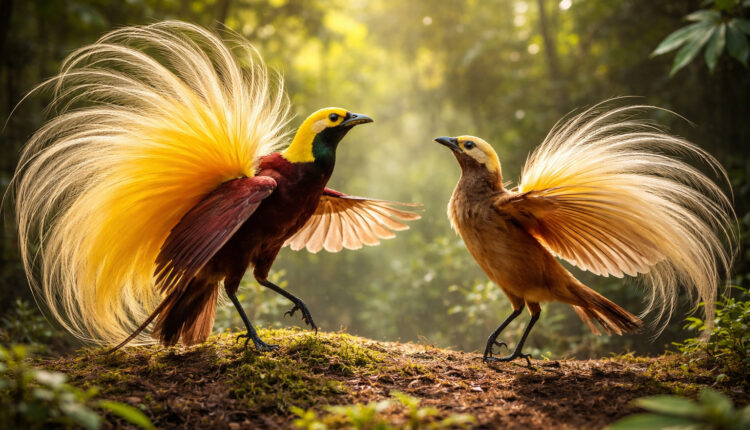
Physically, the greater yellow bird-of-paradise is one of the largest members of its family, measuring over 40 centimeters. Males possess broad rounded wings ideal for their iconic leaping and fluttering courtship display. Its long, trailing tail feathers glow softly in shades of gold. The male’s emerald-green head and pale blue bill contrast sharply with its silky yellow plumes. Females, in contrast, are far less showy—dressed in muted brown tones that provide camouflage during nesting.
This pronounced difference between the sexes, known as sexual dimorphism, reflects intense sexual selection. Ornithologist Richard Prum, in The Evolution of Beauty (2017), described how female choice over generations drove the evolution of such extravagant male ornamentation.
Courtship Dance: Nature’s Theater
The greater yellow bird-of-paradise practices a unique leking system, where males gather in open arenas to perform, while females observe and select their mates. The male’s performance includes leaps, wing extensions, and dramatic poses known as “wing pose,” “pump,” “bow,” and “dance.”
Research conducted in Wasur National Park (2013) found that singing and dancing activity peaks from 8 a.m. to noon. This ritualistic performance—precise, rhythmic, and almost balletic—justifies its reputation as the forest’s most skilled dancer.
A Fragile Paradise Habitat
The bird’s native range covers southern Papua and the Aru Islands. It thrives in lowland tropical rainforests, where humidity and rainfall exceed 3,000 millimeters annually. Towering canopies, averaging 24 meters high, provide both abundant fruit and sturdy branches for display courts.

A 2013 study by Wasur National Park authorities emphasized that lek behavior depends strongly on intact primary forests—making habitat conservation critical for the species’ survival.
Diet and Ecological Role
The greater yellow bird-of-paradise feeds mainly on forest fruits, particularly Ficus and Mangifera species, supplemented by insects and arthropods. This diet makes it an essential seed disperser that contributes to forest regeneration.
Scholar Jared Diamond, in Guns, Germs, and Steel (2005, revised edition), highlighted that large frugivorous birds play a keystone role in sustaining tropical biodiversity.
Evolutionary Kinship and DNA Insights
Scientifically, the bird belongs to the Paradisaeidae family—comprising 44 species across 17 genera—and shares ancestry with crows and jays. Mitochondrial DNA studies (Irestedt, 2009) suggest the family originated about 24 million years ago. Paradisaea apoda forms a close clade with Paradisaea raggiana, and natural hybrids of the two have been found in Wasur, indicating ongoing genetic interaction.
Reproduction and Life Cycle
The greater yellow bird-of-paradise matures slowly. Males reach full sexual maturity at around five to seven years, while females typically lay only one egg per breeding cycle. Nests, made from leaves and vines, rest high on branches.
The incubation period lasts about 18–22 days, with females solely responsible for brooding and nurturing the chick. This low reproductive rate makes the species vulnerable to environmental disturbances and hunting. In the wild, individuals live up to 15–20 years, while those in captivity can live longer under near-natural conditions. However, these birds are highly sensitive to stress; even loud noise can disrupt their mating rituals. Hence, experts advocate habitat-based conservation over intensive captive breeding programs.
Threats and Conservation Status
Cendrawasih populations once suffered heavily from plume hunting during the early 20th century, when their feathers were prized in European fashion. Today, deforestation and habitat fragmentation pose the greatest threats.
Although the IUCN currently lists the species as “Least Concern,” numbers are declining. The Convention on International Trade in Endangered Species (CITES) includes it under Appendix II, meaning trade is tightly regulated to prevent overexploitation.
Cultural Meaning and Modern Conservation
In Papuan tradition, the cendrawasih symbolizes courage, status, and spiritual connection with ancestors. Its feathers were once used in rituals believed to bring blessings and protection. Increasing awareness of conservation, however, is replacing exploitation with stewardship.
A 2018 National Geographic Indonesia feature, “Surga Burung di Tanah Papua,” reported a rise in community-based birdwatching tourism that reduces local hunting. By protecting their forests, Papuans ensure that the golden bird of paradise continues to dance gracefully—free and radiant—in its natural stage.
Indonesianpost.com | GNFI
