
Deputy FM Anis Matta maps Indonesia’s engagement with Muslim-majority countries
00:00
00:00


- Indonesia’s deputy foreign minister says Jakarta’s engagement with the Islamic world is guided by solidarity, humanitarian action, culture and geography.
- At a Cairo seminar, officials highlighted a new roadmap for Indonesia’s Middle East and Islamic-world outreach and the April 2025 strategic partnership declaration with Egypt.
- Speakers stressed deeper Indonesia–Egypt cooperation across politics, education and trade, with media and research communities also present at the forum.
Indonesian Deputy Foreign Minister Muhammad Anis Matta said Indonesia’s engagement with the Islamic world is shaped by “four main geopolitical arenas”: solidarity, humanitarian action, culture and geography. He added that Indonesia’s ties with Muslim-majority societies run deep across multiple levels, from cultural affinity to opportunities for stronger economic integration.
Anis Matta made the remarks at a high-level seminar titled “Indonesia and Integration in the Islamic World… A New Roadmap,” held by the Dialogue Center for Political and Media Studies in cooperation with the Indonesian Embassy in Cairo. The event took place on the sidelines of the deputy foreign minister’s visit to Egypt and highlighted a joint study produced through research collaboration between the Foreign Ministry’s policy strategy agency and the International Relations Studies program at the Indonesian Islamic University.
The seminar opened with Maj. Gen. (ret.) Hamdy Labib, head of the Dialogue Foundation for Humanitarian Studies and Research, who underscored Indonesia’s weight in the Islamic world as the world’s most populous Muslim-majority nation. He pointed to the long history of relations and exchange between Cairo and Jakarta, as well as what he described as broad prospects for closer ties in the coming period. He also said bilateral relations have gained fresh momentum in recent years, driven by political leadership in both countries, with presidential diplomacy and official and public engagement reinforcing cooperation.
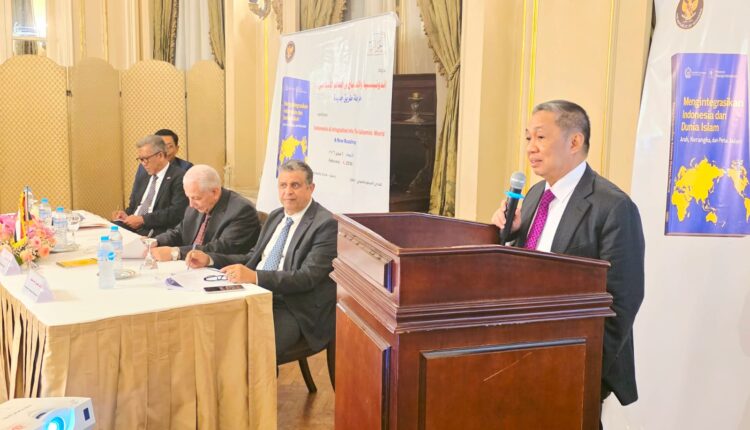

Indonesian Ambassador to Egypt, Kuncoro Giri Waseso, stressed the depth and durability of Indonesia–Egypt relations, describing them as wide-ranging across politics, education and trade. He said Egypt is not only a strategic partner but also a source of intellectual and spiritual inspiration for Indonesia. He noted that a joint declaration on a strategic partnership signed by the two countries’ leaders in April 2025 marked an important milestone in strengthening longstanding ties.
The ambassador added that Indonesia is currently working to shape a new roadmap for its engagement with the Middle East and the broader Islamic world, reflecting the region’s importance to global peace, economic stability and the future direction of the Muslim community.
Anis Matta then outlined key elements of Indonesia’s foreign-policy vision toward the Islamic world, touching on historical roots and domestic shifts that have helped shape the republic’s diplomatic orientation. He argued that moving from broad concepts to practical partnerships requires clarity on priorities and on the “circles” in which Jakarta operates across the wider Islamic sphere.
In the same discussion, journalist Ahmed Mahmoud, managing editor of the English-language edition of Al-Ahram’s online portal, emphasized the need to further advance Egypt–Indonesia cooperation while highlighting the media’s role in shedding light on Indonesia’s moves within its Islamic neighborhood. The seminar drew wide attendance from political, diplomatic and research figures focused on Indonesian and Asian affairs, including Egypt’s East Asia director at the Foreign Ministry, Ambassador Hisham El-Saeed, as well as a number of ambassadors, former assistant foreign ministers and prominent military and research leaders.
Source: Indonesiaalyoum.com
