
Nadiem Makarim Sentenced to 10 Years in Prison Over Chromebook Graft
00:00
00:00


- The Jakarta Corruption Court sentenced former Education Minister Nadiem Makarim to 10 years in prison and a Rp 1 billion fine for abusing his authority in the corrupt procurement of Chromebook laptops, which caused Rp 1.56 trillion in state losses.
- Judges found that Nadiem deliberately directed national education digitalization policies to favor Google’s Chrome OS, utilizing his special staff to bypass internal regulations and suppress objections from ministry officials.
- While the court majority found Nadiem guilty and suggested a follow-up money-laundering probe, one judge issued a dissenting opinion, arguing for his acquittal due to a lack of evidence tying the former minister directly to kickbacks or the technical tender process.
JAKARTA — The Jakarta Corruption Court has found former education minister Nadiem Makarim guilty in the Chromebook laptop procurement corruption case and sentenced him to 10 years in prison, according to court proceedings on Tuesday.
Presiding Judge Purwanto S. Abdullah said the panel had found Nadiem Anwar Makarim “legally and convincingly guilty” of corruption committed jointly with others, as set out in the subsidiary indictment. He added that the court had imposed a 10-year prison term and a fine of Rp 1 billion.
The sentence was lighter than the prosecutors’ demand of 18 years in prison. The court also ordered restitution amounting to Rp 809,590,125,000.
The judges rejected the prosecutors’ request for Nadiem to pay Rp 4.8 trillion, ruling that the legal path taken by the prosecution to demand that specific amount was inappropriate.
The panel also recommended that the Attorney General’s Office (AGO) continue tracing Nadiem’s assets through a money-laundering investigation.
“The panel recommends that investigators at the Attorney General’s Office continue asset tracing through an investigation into money laundering, with Article 3 of the Corruption Law as the predicate offense,” the judge said.
The court held that Nadiem did not meet the legal elements under Article 2 paragraph (1) of the Anti-Corruption Law concerning unlawful acts causing financial loss to the state. However, the judges found that he had fulfilled the elements under Article 3 concerning the abuse of authority.
Nadiem’s Actions
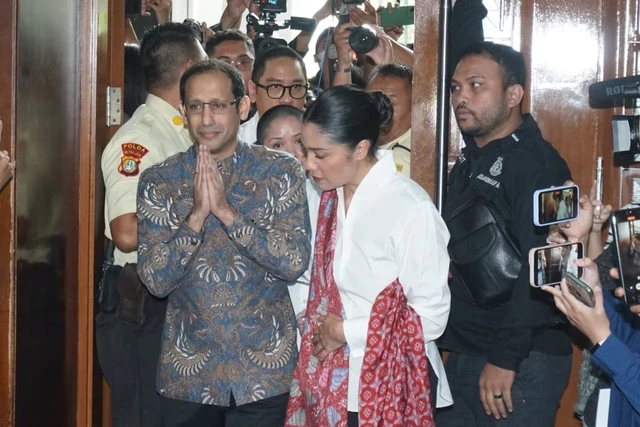
The panel stated Nadiem’s conduct was carried out through the authority attached to his office as minister, placing him at the top of the ministry’s policymaking structure.
“All of the deviations revealed in court—starting from the assignment of roles through the authority of special staff and internal consultants, policy direction, and the locking in of specifications through a ministerial regulation—stemmed from the use of official authority and not from acts outside of his official duties,” the judge explained.
According to the indictment, Nadiem and others were involved in the procurement of information and communication technology (ICT) learning facilities in the form of Chromebook laptops and Chrome Device Management (CDM) systems for the 2020, 2021, and 2022 fiscal years.
In this case, the court found a deliberate effort to benefit Google through the education digitalization program by steering procurement toward Chromebooks using Chrome OS and Chrome Device Management.
These efforts were allegedly carried out through the placement of ministerial special staff acting beyond their authority, the inclusion of external consultants in the technical team, and the issuance of a ministerial regulation that mandated Chrome OS while blatantly disregarding the advice of internal teams.
The judges also found that Nadiem was actively involved in the selection of those specifications. The court cited minutes from a May 27, 2020, meeting stating that the shift from Windows to Chrome OS was made “in line with Mas Menteri’s [the Minister’s] direction,” as conveyed by Nadiem’s special staff member, Jurist Tan.
“As a result, the meeting participants stopped objecting,” the judge noted.
Nadiem’s Role

The court said Nadiem, as minister, occupied the highest point in the chain of authority that was later abused. As both minister and budget user, he held attributed authority over the education digitalization program and signed the Education and Culture Ministerial Regulation No. 5/2021, which formally set Chrome OS as the required specification.
The judges laid out what they saw as Nadiem’s specific contributions to the corruption case, ranging from the strategic appointment of special staff to the sidelining of legal objections raised within the ministry.
“The defendant’s contribution was manifested in a series of mutually reinforcing acts, namely the placement of a ministerial special staff member beyond the authority permitted under Ministerial Regulation No. 68/2019, the placement of external consultant Ibrahim Arif into the technical team, a series of strategic meetings with Google in February and April 2020, the ‘go ahead’ acknowledgment at the May 6, 2020, meeting that was used by the technical team as the basis for selecting Chrome OS, and the signing of Ministerial Regulation No. 5/2021, whose appendix established Chrome OS while disregarding the Legal Bureau’s advice dated Dec. 10, 2020,” the judge outlined.
“Although the defendant did not directly carry out technical procurement acts, the chain of decisions, strategy, direction, policy, and regulatory approvals constituted a decisive contribution, without which the crime would not have occurred in the way that it did,” the judge added.
Jurist Tan as a Central Actor


In its findings, the panel also pointed to sudden personnel changes at the Education, Culture, Research, and Technology Ministry that it said directly affected the procurement process. The judges referred to the replacement of Junior High School Director Mulyatsyah and Elementary School Director Sri Wahyuningsih, both of whom had opposed additional ICT budget allocations on technical and administrative grounds. Both individuals have also been convicted in this broader case.
The court said the two officials later received sudden reassignment decrees, with Mulyatsyah eventually opting for early retirement.
The judges then highlighted what they described as Jurist Tan’s central role in those personnel changes.
“In both of those replacement events, Jurist Tan, as the minister’s special staff member, was involved as the central actor who led meetings and/or determined personnel decisions. According to Mulyatsyah’s testimony, Jurist Tan exercised immense power in government affairs, regulation, finance, and human resources, including the transfer and promotion of ministry officials,” the judge said.
State Losses
The court detailed the state financial losses arising from the rigged procurement as follows:
-
2020: Rp 127,980,348,338.15
-
2021: Rp 544,596,543,361.43
-
2022: Rp 895,304,775,017.16
“Thus, the total state financial loss from the overall procurement of 1,109,327 units reached Rp 1,567,888,662,716.74,” the judge stated.
One Judge Pushes for Acquittal
The verdict, however, was not unanimous. The ruling contained a dissenting opinion from Judge Andi Saputra, who argued that Nadiem should have been fully acquitted.
According to Andi, Nadiem was not directly involved in the procurement process because he had no capacity to determine the tender, auction, or technical procurement mechanisms. He said this was supported by substantive evidence showing no direct or indirect intervention by Nadiem in the actual tender.
“There was also no kickback or gratification in any form received by the defendant from budget authority holders, procurement committees, civil servants at the ministry, private parties, or any other party that benefited from the alleged inflated pricing,” Andi explained.
“The defendant was also not affiliated with, nor did he hold shares in, any laptop company,” he added.
Judge Andi also addressed Google’s investment cooperation with PT Aplikasi Karya Anak Bangsa (PT AKAB/Gojek). He stated that the investment was purely a business matter and had no connection to the ministerial decisions made by Nadiem, who is a co-founder of the ride-hailing company.
“There is no strong evidence indicating the defendant’s involvement or of any trading in influence committed by Nadiem Anwar Makarim,” Andi asserted.
Andi acknowledged that, based on a report from the Financial and Development Supervisory Agency (BPKP), state losses had indeed occurred due to marked-up prices in the procurement. However, he referred to the rulings against other convicted defendants in the same case, which he argued found no unlawful act or abuse of authority on Nadiem’s part.
“It has emerged that the state losses were caused by a criminal conspiracy between the procurement committee and third parties,” Andi noted.
He highlighted that while several witnesses admitted during the trial to receiving kickbacks from vendors, not a single witness testified that Nadiem had received any portion of those illicit funds.
“The facts revealed in court show that not a single witness stated that the defendant received any flow of funds from kickbacks. In the laptop procurement, there was also no flow of funds to the minister’s special staff, witness Ibrahim Arief, the defendant’s family, or at least to anyone with a particularly close relationship with the defendant,” Andi elaborated.
“Therefore, it must be firmly concluded that the kickback scheme operated at the committee level. Procurement dealings with third parties should be investigated further by investigators or prosecutors in order to uncover the material truth,” he continued.
Judge Andi concluded that the evidence was insufficiently clear to establish malicious intent (mens rea) on Nadiem’s part. Therefore, he argued that Nadiem should walk free.
“Because the defendant has not been legally and convincingly proven guilty of committing the criminal offense as charged in either the primary or subsidiary indictment, the Defendant, Nadiem Anwar Makarim, should be acquitted of all charges,” he declared.
KUMPARAN | INDONESIA ALYOUM | INDONESIAN POST
