
Why Moving Javan Rhinos to Alas Purwo Would Be No Simple Task
00:00
00:00


- Potential Second Habitat: Indonesia is exploring Alas Purwo National Park as a potential second habitat for Javan rhinos, but no relocation decision has been made.
- Complex Relocation Challenges: The species’ specialized diet, habitat requirements and solitary behavior make any proposed move a complex undertaking.
- Vulnerable Wild Population: An estimated 50 Javan rhinos remain in the wild, all in Ujung Kulon National Park, leaving the population vulnerable to threats affecting a single location.
JAKARTA, Indonesianpost.com — A proposal to move Javan rhinos from Ujung Kulon National Park in Banten province to Alas Purwo National Park in Banyuwangi regency, East Java, has drawn public attention. Supporters describe the idea as a way to protect the rare species from the risk of extinction caused by natural disasters.
But relocating Javan rhinos is no simple undertaking. The species, known scientifically as Rhinoceros sondaicus, has distinctive traits and specific habitat requirements that must be considered before introducing it to a new environment.
Indonesia’s Forestry Ministry has identified Alas Purwo as a potential site to assess as a second habitat. However, discussions remain exploratory, and no decision has been made to relocate the animals.
“Site selection must be based on scientific evidence and adequate risk assessments. The animals’ safety and the habitat’s capacity to support a healthy population that can grow sustainably are the primary considerations,” Ristianto Pribadi, head of the ministry’s Public Relations and International Cooperation Bureau, said in an official statement cited on the ministry’s website on Tuesday, November 17, 2026.
What makes the Javan rhino one of the world’s rarest mammals? The following facts, compiled from several sources, explain its characteristics and the challenges involved in its conservation.
A Single Horn and a Body Weighing More Than a Metric Ton
The Javan rhino is one of the world’s five surviving rhinoceros species. Its defining feature is a single horn that is relatively small compared with those of other rhino species.
According to the International Rhino Foundation (IRF), a male Javan rhino’s horn can grow to about 25 centimeters. Females typically have smaller horns or none at all.
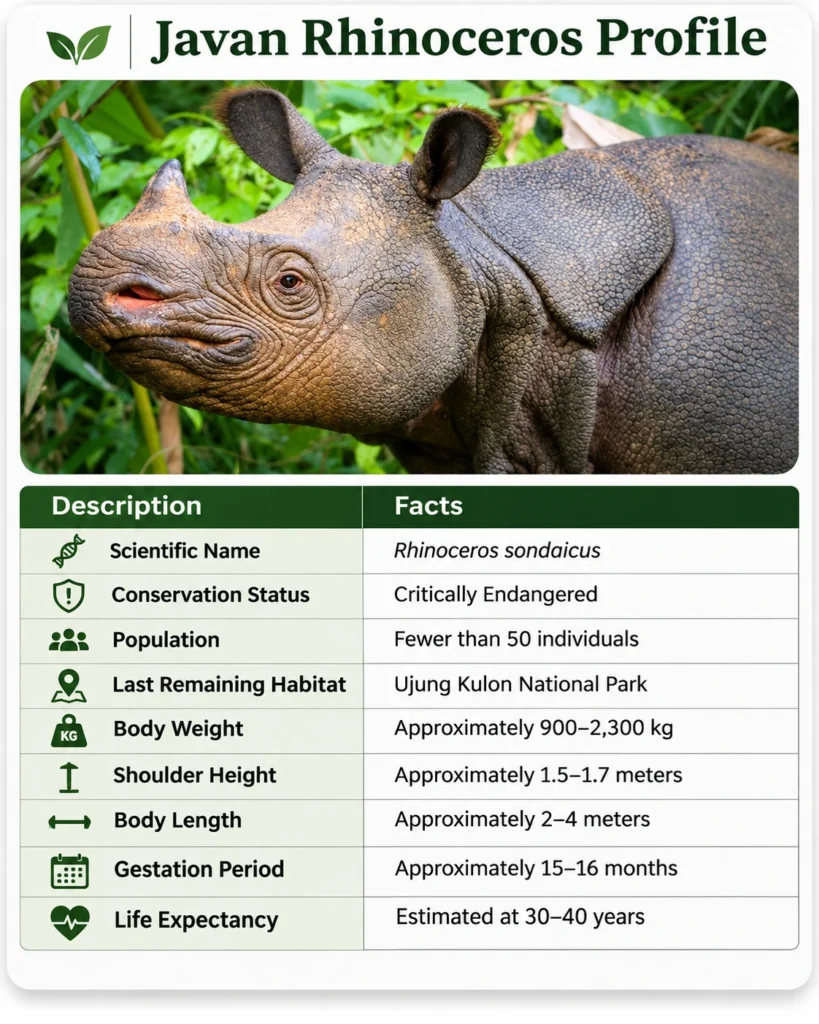
Javan rhinos have gray skin with folds that resemble protective armor. They weigh between 900 and 2,300 kilograms, stand about 1.5 to 1.7 meters at the shoulder and measure two to four meters in body length.
With a lifespan of 30 to 40 years, the species has a flexible, pointed upper lip that helps it grasp leaves and other plant material.
Leaf Eaters That Wallow in Mud

Contrary to the assumption that all rhinos graze on grass, Javan rhinos are browsers: herbivores that feed on leaves, tender shoots and fruit from woody plants, including shrubs and trees.
According to the International Union for Conservation of Nature’s Species Survival Commission Asian Rhino Specialist Group, Javan rhinos feed on vegetation in lowland tropical rainforests. They use their grasping upper lips to pull branches and shoots within reach.
Alongside feeding, Javan rhinos regularly wallow in mud, an important part of their natural behavior. They are also known to visit particular sites to obtain minerals their bodies need.
Their dependence on natural food supplies, water sources and mud wallows makes habitat suitability a central consideration in any proposed relocation.
Solitary and Difficult to Observe
Javan rhinos are generally solitary. Adult encounters usually occur during mating, while mothers remain with their calves.
The Asian Rhino Specialist Group also describes Javan rhinos as exceptionally difficult to encounter in the wild. Much of what researchers know about their behavior and population characteristics comes from camera traps, dung surveys and footprints rather than direct observation.
These traits mean monitoring the population requires specialized technology and methods. Camera traps are important tools for identifying individual rhinos, tracking their activities and detecting new calves in Ujung Kulon.
Slow Reproduction Complicates Recovery
One of the biggest challenges in Javan rhino conservation is the species’ relatively slow reproductive rate. Gestation is estimated to last about 15 to 16 months. Females generally give birth to a single calf, with an estimated interval of two to three years between births.
Calves also take considerable time to develop before they can live independently. As a result, the population cannot recover quickly.
The IRF estimates that about 50 Javan rhinos remain in the wild. All live in Ujung Kulon National Park, making the species highly vulnerable to threats that could affect the entire area. [Detik/Bilah]
