
Inside Indonesia’s Silent Crisis: Corruption, Job Insecurity and Fiscal Strain


- Indonesia’s latest data reveal a widening gap between official success stories and on-the-ground realities, from entrenched customs bribery to an economy increasingly reliant on insecure informal jobs.
- While the government celebrates food self-sufficiency, a 17-hour blackout in Sumatra, a Rp 12 trillion welfare bottleneck and mounting debt costs are exposing deep structural weaknesses in Indonesia’s institutions.
- Growing public calls for accountability, combined with international concern over low tax revenue and high interest burdens, suggest Indonesia’s biggest threats are now domestic—rooted in governance, not global shocks.
On the surface, the narrative of the new administration is one of decisive triumph. President Prabowo recently heralded the achievement of rice and corn self-sufficiency, backed by Ministry of Agriculture data showing record-breaking rice stocks of 5.3 million tons. It is a compelling headline, yet newly released socio-economic data suggests that while the silos are full, the institutional and structural foundations of the nation are showing deep, jagged cracks. Beyond the official targets lies a reality defined by institutional paralysis, a labor market in retreat, and a fiscal fragility that global “shocks” can no longer fully excuse.
The 2.9 Billion Rupiah Monthly “Subscription”
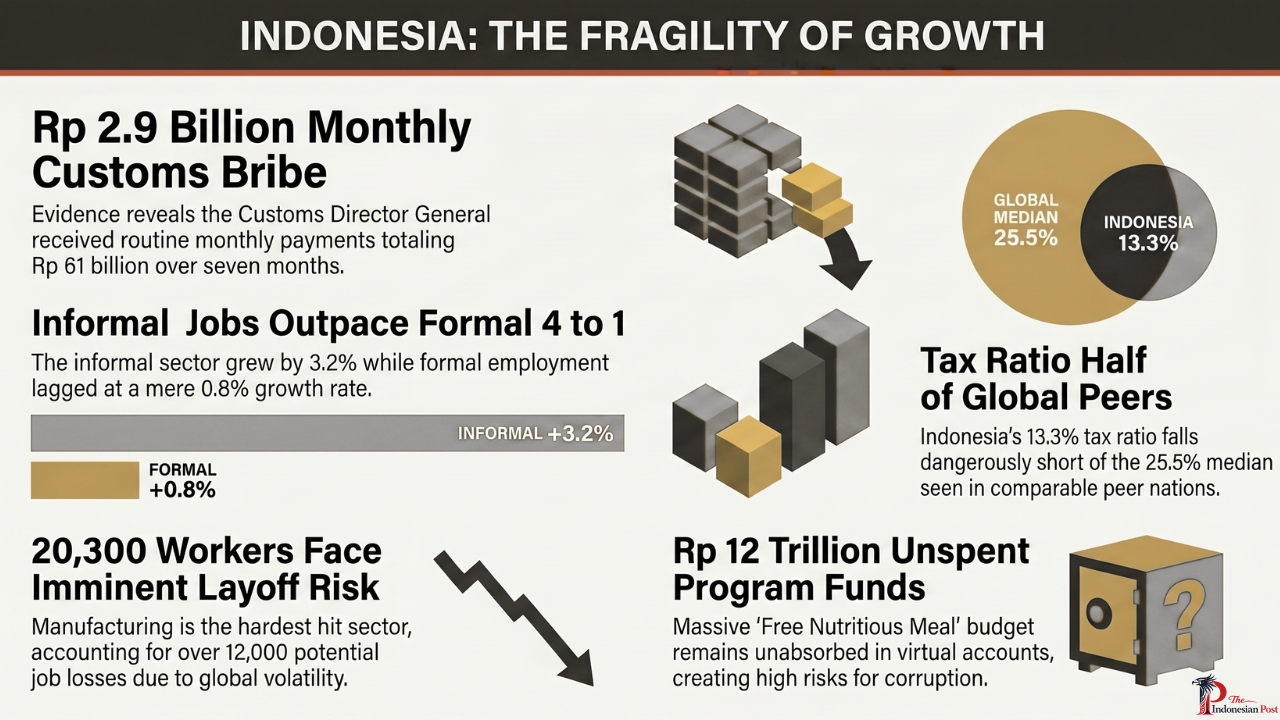
The integrity of the borders tells a different story than the bounty of the fields. Recent proceedings at the Central Jakarta District Court have pulled back the curtain on a systematic bribery scheme within the Directorate General of Customs and Excise that is as efficient as it is brazen. Evidence presented by the KPK prosecutor indicates that Director General Djaka Budi Utama allegedly received a monthly “quota” of approximately Rp 2.9 billion.
The speed of this ethical decay is perhaps the most damning detail: Djaka was appointed by the President in May 2025; by July 2025—just two months into his tenure—the “setoran” (deposits) had already begun. Between July 2025 and January 2026, a total of Rp 61 billion was allegedly funneled to various officials. The choice of currency—Singapore Dollars—speaks to a sophisticated effort at concealment and ease of transport.
Even more troubling is the resulting institutional paralysis. Finance Minister Purbaya, despite being Djaka’s direct superior, has stated she is “waiting for presidential orders” before taking action. This hesitation likely stems from Djaka’s direct presidential appointment and his controversial history as a former member of the “Tim Mawar,” who was previously imprisoned in 1999 for the kidnapping of activists.
“The prosecutor displayed photos of envelopes marked with specific codes and company records detailing the bribery schedule. The monthly quota for Director General Djaka Budi Utama was set at 213,600 Singapore Dollars, or approximately Rp 2.9 billion.”
The “Informalization” of the Indonesian Dream
For decades, the “Indonesian Dream” was built on the back of stable, formal employment. However, research from CORE Indonesia covering the 2021–2025 period reveals a troubling reversal. While formal employment grew by a stagnant 0.8%, the informal sector exploded by 3.2%. This means the informal economy is now growing at four times the rate of the formal sector.
This isn’t just a statistical quirk; it is the “informalization” of an entire generation. The formal sector has effectively failed to absorb the national workforce, leaving the middle class in a state of chronic fragility. This vulnerability is set to sharpen as a wave of layoffs looms, driven by a heavy reliance on imported raw materials and global volatility.
Estimated Imminent Layoffs by Sector:
- Manufacturing: 8,700 – 12,100 workers
- Agriculture: 3,300 – 6,000 workers
- Services: 3,300 – 4,500 workers
The 12 Trillion Rupiah Bottleneck

The “Makan Bergizi Gratis” (MBG) program—a cornerstone of the current administration’s social contract—is currently being strangled by its own momentum. The National Anti-Corruption Strategy (Stranas PK) has discovered that Rp 12 trillion is currently sitting idle in virtual accounts.
The program is moving too fast for its oversight mechanisms to keep up, leading to a massive fiscal bottleneck where money is “trapped in the digital pipes” instead of stimulating local economies. The irony is sharp: while the program was pitched as a boon for local farmers, outside suppliers currently dominate the chain, with local involvement languishing at a measly 1.54%. Without a “last-mile” execution strategy, this stagnant fund remains a high-risk target for the same type of leakage seen in the Customs office.
Domestic Alarms: Moving Beyond the “Global Factors” Excuse
Whenever the Rupiah falters, the standard official response is to point toward the Middle East or Federal Reserve policy. Josua Pardede, Chief Economist at Permata Bank, argues that this shield is wearing thin. The real alarms were ringing long before the latest geopolitical flare-ups.
Global investors are increasingly judging Indonesia on its internal discipline—or lack thereof. Two specific domestic metrics are driving the current negative outlook from agencies like Moody’s and Fitch:
- The Revenue Gap: Indonesia’s tax-to-GDP ratio is stuck at 13.3%, roughly half the 25.5% median of its BBB-rated peer countries.
- The Debt Trap: Interest payments on government debt have ballooned to Rp 599.4 trillion, consuming a staggering 19% of total state revenue.
When nearly one-fifth of the national budget is spent merely on servicing interest, the “fiscal space” for meaningful development begins to vanish.
The “Sumatra Blackout” as a Metaphor for Infrastructure
The physical manifestation of this “fragile quality” growth occurred recently across five provinces in Sumatra. A 17-hour power outage, triggered by a failure in the 275 kV transmission line between Muara Bungo and Sungai Rumbai, plunged millions into darkness.
As “Mati lampu” trended on social media, it became a potent metaphor for the gap between government rhetoric and daily reality. You can announce record-breaking rice stocks and state-of-the-art infrastructure projects, but when a single transmission failure can paralyze half an island for nearly a full day, the “quality” of that progress is brought into question.
The Path Forward
Indonesia is currently a nation of contradictions. There is undeniable success in food production and a growing, vocal demand for public accountability. Yet, these gains are being cannibalized by institutional “leakages” and a labor market that offers no security.
The data suggests that the greatest threats to Indonesia’s future are no longer external; they are structural and internal. The question is no longer whether the administration can hit its numerical targets on a spreadsheet. The real question is whether the state has the courage to address the root causes of corruption and fiscal indiscipline before the 17-hour darkness in Sumatra and the evaporation of formal jobs lead to a terminal crisis of public trust. Is the administration’s definition of “success” fundamentally disconnected from the reality of the people it serves?
