
TNI Deployed to Hunt Robbers, DSI Claims No Profit from Exports, Sacrificial Animal Sales Slump


By MAKPI–BDS Alliance Desk | Jakarta, May 26, 2026
- Indonesia sends in the military, rewires export rules and struggles to shield households from rising economic pressure.
- A new DSI-led export regime and weak Idul Adha sales reveal a fragile economy behind Jakarta’s bold interventions.
- From TNI patrols to palm oil price shocks, policy choices are testing trust in Indonesia’s legal and economic reforms.
A cluster of major political, security and economic developments came to a head on Tuesday, drawing public attention across multiple fronts. From the military’s deployment on Jakarta’s streets to chase violent motorcycle robbers, to a contested new export framework that has pushed palm oil farmers’ prices below survival levels, the day’s events painted a picture of a government that is increasingly interventionist yet still struggling to turn policy intent into predictable market outcomes.
LAW & ORDER
Military deployed to hunt motorcycle criminals in Greater Jakarta
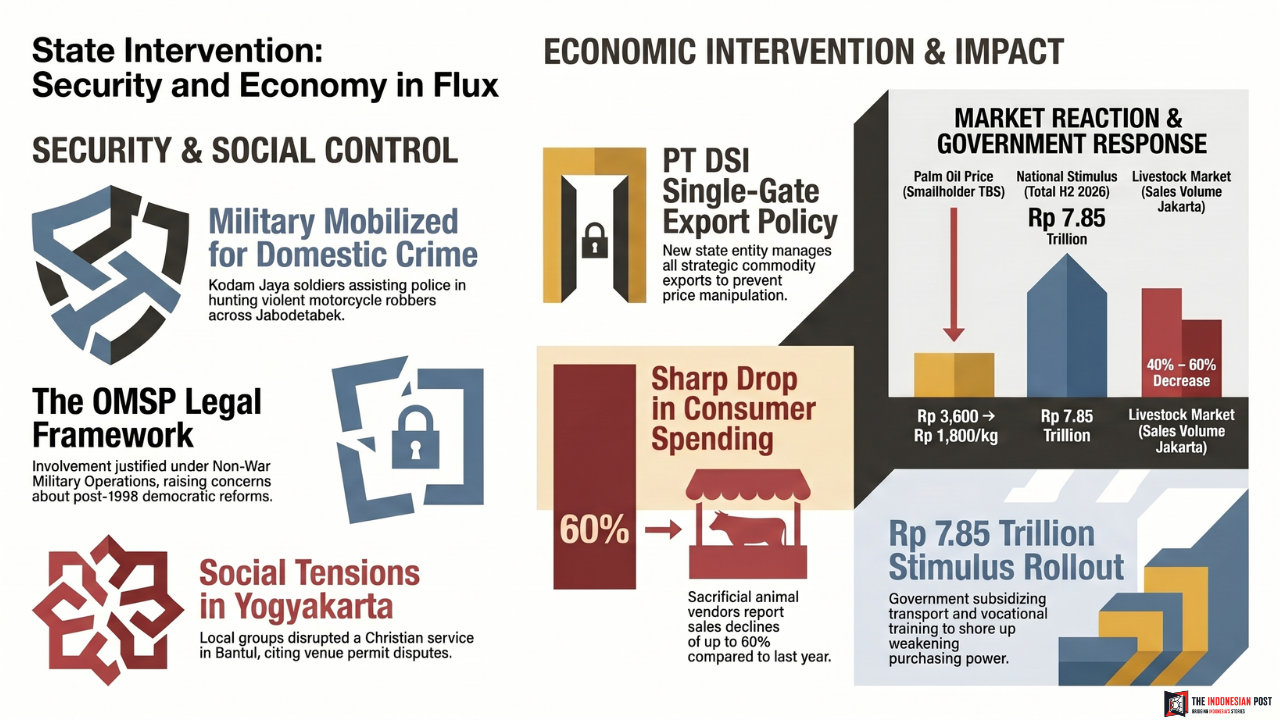
Soldiers from the Jaya Regional Military Command (Kodam Jaya) have been deployed alongside personnel from the Greater Jakarta Police (Polda Metro Jaya) to pursue violent street criminals, locally known as begal, across the Greater Jakarta (Jabodetabek) area, which includes Jakarta, Bogor, Depok, Tangerang and Bekasi. Kodam Jaya public affairs chief Lt. Col. (Arh.) Noor Iskak confirmed that personnel from district military commands (Koramil), area-level commands (Kodim) and combat battalions have been mobilized to conduct joint patrols with the police, reflecting growing public anxiety over street crime in the capital region.
TNI Central Information chief Brig. Gen. Muhammad Nas said that while no direct order had been issued by TNI Headquarters, commander Gen. Agus Subiyanto had given his full support for soldiers to assist the police in the operation. Defense Ministry Information Bureau chief Brig. Gen. Rico Ricardo Sirait clarified that the military’s involvement is covered under Non‑War Military Operations (Operasi Militer Selain Perang, OMSP), a legal framework that allows limited deployment in support of civilian authorities.
Worship service disrupted in Bantul, Yogyakarta governor responds
A video that circulated widely on social media this week showed a heated confrontation at a Christian worship gathering, accompanied by captions describing it as the forced dispersal of a religious service, while two police officers at the scene appeared to stand by and watch. Yogyakarta Police public relations chief Sr. Comr. Ihsan confirmed that members of the Islamic Jihad Front (Front Jihad Islam, FJI) arrived while congregants of the Gereja Misi Sejahtera (GMS) church were holding a service and demanded that they stop.
The FJI group argued that GMS was using a venue that had not been granted an official permit to function as a place of worship. The incident took place in Glugo hamlet, Panggungharjo village, Sewon district, Bantul regency, in the Yogyakarta Special Region (DIY). Yogyakarta Governor Sri Sultan Hamengku Buwono X responded by saying that diversity is not only a social reality but a divine given, and that no single group holds a monopoly on truth in managing differences in a pluralistic society.
Attorney General’s Office probes palm oil firms over export price manipulation
The Attorney General’s Office (Kejagung) has launched a formal investigation into a number of palm oil companies suspected of manipulating export prices through transfer pricing. Director of investigation at the Special Crimes Division Syarief Sulaeman Nahdi said the companies under scrutiny include the same 10 firms recently named by Finance Minister Purbaya in a public statement.
Purbaya previously disclosed that a random sample of 10 companies from the palm oil exporters’ list revealed alleged price manipulation of around US$84 million, a figure now at the center of the Attorney General’s probe.
POLITICS
Prabowo performs Idul Adha prayers in France during state visit
President Prabowo Subianto will not be in Indonesia for the Idul Adha 1447 Hijri prayers. Deputy state secretary Juri Ardiantoro announced that the President departed for France on Monday evening for an official working visit, his fourth trip to the country since taking office after visits in July 2025, January 2026 and April 2026.
Despite his absence, Juri said President Prabowo had arranged for 1,098 sacrificial cattle to be distributed to communities across Indonesia in observance of Idul Adha.
Parliament mulls extending police retirement age
The House of Representatives’ Commission III is deliberating a revision to Law No. 2/2002 on the National Police (Polri). Deputy House Speaker Sufmi Dasco Ahmad said one of the key proposed changes is an extension of the mandatory retirement age for police officers to bring it in line with the retirement ages already applicable to personnel at the Attorney General’s Office and the Indonesian Military, both set at 60 years, compared with the current 58‑year cap for the police.
Law Minister Supratman Andi Agtas pushed back against suggestions that the revision is designed to benefit National Police chief Gen. Listyo Sigit Prabowo, who is currently 57 years old, calling such claims speculative and politically driven.
ECONOMY
Government rolls out Rp 7.85 trillion stimulus for H2 2026
Coordinating Economic Affairs Minister Airlangga Hartarto announced that the government will roll out a new round of economic stimulus measures for the second half of 2026, including the school holiday period, totaling Rp 7.85 trillion. The package includes an extension of the government‑borne value‑added tax (PPN DTP) incentive on domestic airline tickets, discounts on land and sea transport fares, a national apprenticeship program and a final income tax rate of 1.5 percent for authors and writers.
For the school holiday period, discounts on land and ferry transport are valued at Rp 190 billion, while domestic airfare discounts reach Rp 447.2 billion. For the Christmas and New Year holidays, the PPN DTP incentive stands at Rp 772 billion, with land transport and ferry subsidies totaling Rp 161.4 billion. The fourth batch of the national apprenticeship program, targeting 150,000 participants, will receive Rp 4.14 trillion, while vocational training programs are allocated Rp 2.12 trillion.
Deputy agriculture minister: DSI will not profit from palm oil exports
Deputy Agriculture Minister Sudaryono moved to reassure palm oil farmers that PT Danantara Sumber Daya Indonesia (DSI) – the newly established state‑linked entity at the center of the government’s single‑gate export policy – will function strictly as a manager and supervisor of export activities and will not take profit from palm oil export transactions.

The clarification came in response to complaints from farmers who saw prices for fresh fruit bunches (TBS) collapse after the government unveiled the single‑gate export scheme. Sudaryono said 139 palm oil mills had already lowered their TBS purchase prices and urged them to immediately adjust their rates upward following his explanation.
Indonesian Palm Oil Farmers Association (Apkasindo) chairman Gulat Manurung said after meeting the deputy minister that TBS prices for independent smallholders had fallen from Rp 3,600 per kilogram to Rp 1,800 per kilogram in the immediate aftermath of the announcement – well below the production cost of Rp 2,000 per kilogram. Indonesian Palm Oil Association (Gapki) chairman Eddy Martono separately acknowledged that industry players were confused over how the new policy would work in practice.
Sacrificial animal sales drop sharply ahead of Idul Adha
Several vendors selling sacrificial animals ahead of Idul Adha reported a significant drop in sales compared with last year, offering a street‑level illustration of weakening consumer purchasing power. Dede, a vendor in Penggilingan, East Jakarta, said he had only managed to sell 16 animals by the day before Idul Adha, around 60 percent less than the 40 animals sold over the same period last year.
Another vendor, Kirtam, in Cipinang Melayu, reported selling about 50 animals, down from 70 the previous year. Aware that household budgets are tighter this year, Dede said he had deliberately brought smaller goats priced between Rp 3 million and Rp 3.8 million and expressed hope that last‑minute buyers would help cover the cost of transporting unsold animals back to his supplier.
TRENDING ON SOCIAL MEDIA
“Ritel Raksasa” debate targets major retail chains
The phrase “Ritel Raksasa” (giant retailer) trended on X on Tuesday as numerous users uploaded and shared a video of a man defending comments by Villages, Disadvantaged Regions and Transmigration Minister Yandri Susanto, who had suggested that leading minimarket chains Indomaret and Alfamart should halt operations once the Red‑and‑White Village Cooperative (Kopdes Merah Putih) network becomes fully operational.
Hashtag campaign touts “big agenda” for Prabowo
X was also flooded with videos featuring politician Budiman Sudjatmiko under the hashtag #AgendaBesarPrabowo, in which he argued that President Prabowo has a sweeping agenda to ensure no Indonesian goes hungry, claiming that 108 problems had been resolved within the President’s first 18 months in office.
Jokowi back in political spotlight through PSI
Former president Joko “Jokowi” Widodo was among the top‑searched names on Google. The Indonesian Solidarity Party (PSI) – led by his youngest son – announced that the former head of state would soon visit Lampung, East Nusa Tenggara (NTT) and West Java and would be formally named chair of the party’s advisory board.
EDITOR’S ANALYSIS
Military deployment against street crime
The TNI’s involvement in hunting down street criminals in the Jabodetabek region has sparked a genuine public debate. Many citizens welcome the move as a swift and tangible response to the persistent threat of violent street crime that has long troubled commuters on the capital’s fringes, yet others question where the authority of the military ends and that of the civilian police begins.
Military operations must remain under the tactical command of the National Police and firmly within the corridors of civil law. Without such limits, the spirit of post‑1998 reforms that separated defense functions, assigned to the TNI, from public order and security, assigned to the police, risks being quietly eroded. If Non‑War Military Operations (OMSP) become a catch‑all justification for domestic deployments based on subjective assessments, today’s exception could become tomorrow’s norm.
Single‑gate export policy and the role of PT DSI
PT Danantara Sumber Daya Indonesia, the new state‑linked company, has been positioned as the single gateway for exports of strategic commodities, including palm oil and coal. The stated goal is to plug revenue leakages caused by transfer pricing, a practice in which companies manipulate export prices to shift profits offshore.
While this objective is broadly shared, public debate has quickly moved from why DSI is needed to how it will actually work. Sudaryono’s assurance that DSI will not seek profit from its role has only deepened that debate. By definition, a limited liability company (perseroan terbatas, PT) is designed to generate profit to compensate investors and cover operating costs. If DSI does not intend to make a profit, basic questions remain over how it will be funded and to whom it will ultimately be accountable.
A fragile economic backdrop
Against a backdrop of weakening household purchasing power and rising economic uncertainty, the government appears to be doubling down on large‑scale market intervention. The single‑gate export concept via DSI may have been born of a genuine desire to recover lost foreign exchange earnings and rein in abusive transfer pricing, but the way it was announced exposed familiar institutional weaknesses: unclear design, poor public communication and high implementation risk.
The palm oil market’s reaction was immediate and punishing. TBS prices for smallholder farmers dropped to nearly half their previous level, falling below production cost. It is a reminder that in economics, perception often moves faster than regulation and that poorly communicated policies can inflict real damage long before any legal text takes effect.
At the same time, distress signals from sacrificial animal vendors – with sales down by more than half in some cases – should not be dismissed as mere seasonal fluctuation. They offer a ground‑level indicator of real pressure on household finances. The Rp 7.85 trillion stimulus package can help shore up short‑term consumption and open pathways through apprenticeship and vocational programs, but the structural problem remains: Indonesia’s economy is still heavily reliant on state spending and administrative intervention, while business confidence and market predictability continue to lag.
On the security and social front, a pattern is also visible, from joint TNI–police patrols to the dispersal of a religious gathering, suggesting that the state is leaning more on control mechanisms than on trust‑building ones. In a crisis, such tendencies may be understandable, but they are also trajectories that demand careful scrutiny.
To be fair, efforts to reform export governance and renewed emphasis on vocational training do suggest that an awareness of the need to strengthen domestic economic foundations is gaining ground in policy circles. The harder task now is to ensure that these reforms are implemented with transparency, legal clarity and a genuine commitment to those at the lower rungs of the economy. What Indonesia needs is less institutional rebranding and more accountability.
This brief is produced based on the MAKPI–BDS Alliance update published on Tuesday, May 26, 2026.
